

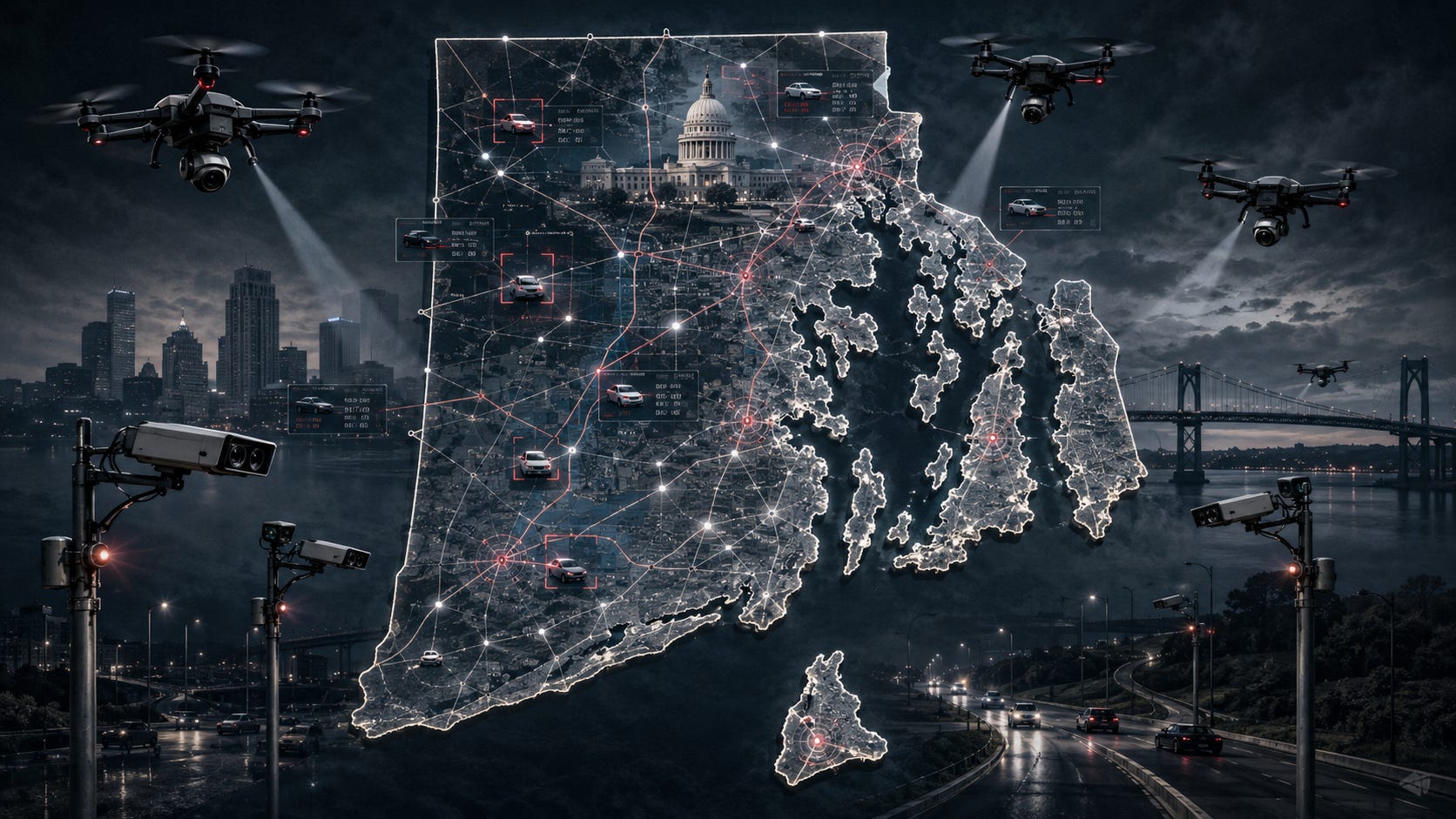
The landscape of municipal surveillance in Rhode Island is undergoing a chaotic and deeply concerning shift. As local law enforcement agencies quietly expand their tech suites, a growing baseline of community resistance is beginning to reject the pervasive tracking mechanisms installed on our public streets. A stark divide has emerged between communities demanding a rollback of automated surveillance networks and towns leaning further into unchecked airborne monitoring programs.
Public pushback has forced several local governments to reconsider their reliance on Flock Safety automated license plate readers (ALPRs). In municipalities like South Kingstown and Tiverton, town councils have been forced to put their Flock contracts under intense scrutiny following massive privacy alarms raised by residents and advocacy groups like the ACLU of Rhode Island.
These systems do not merely read license plates; they continuously log the make, model, color, and unique features of every single vehicle that drives past, creating an unconstitutional dragnet that effectively tracks law-abiding citizens as they go about their daily routines. Compounding this overreach is the fact that many Rhode Island police departments retain the ability to share this captured movement data with hundreds of out-of-state law enforcement entities and federal agencies, turning a local trip to the grocery store into a data point on a national surveillance grid.
While some communities are moving to pull the plug on these predatory roadside cameras, other jurisdictions are expanding their surveillance footprint into the skies. Police departments in Providence, Cranston, Bristol, and Tiverton have already deployed specialized drone units, and agencies in Newport are actively seeking to acquire the same unmanned aerial technology.
This pivot to drones represents an alarming escalation in municipal tracking. Under the guise of tactical support and search operations, local police are introducing high-tech, camera-equipped aircraft into public spaces with virtually no comprehensive statewide laws to limit their deployment or protect the basic privacy rights of the public below.
The structural dangers of this rapid technological expansion have driven urgent legislative responses at the State House, where key lawmakers have fought to establish mandatory guardrails. Leading the charge to rein in these intrusive police tools are Representative Matthew Dawson and Representative Joseph J. Solomon Jr., a prominent voice on municipal oversight who is currently running for Rhode Island Attorney General.
Together, Dawson and Solomon sponsored House Bill 5659, a comprehensive regulatory measure designed to enforce strict privacy protections on automated license plate readers. Their legislation aimed to strip away the unchecked power of corporate dragnets by mandating that collected data be completely purged within 30 days, explicitly banning the recording of vehicle occupants, and establishing strict penalties for data abuse. Solomon, who previously introduced separate legislation to limit governmental tracking, has consistently warned that these high-speed surveillance systems are expanding far faster than the legal policies meant to govern them.
Unfortunately, the General Assembly has repeatedly sidelined these essential protections, choosing once again to hold the regulatory framework for further study and leaving Rhode Islanders completely exposed to unregulated corporate tracking networks. By stalling the vital oversight championed by Dawson and Solomon, state leadership has allowed private entities like Flock Safety to build an unaccountable, highly invasive surveillance grid across our neighborhoods.
Substituting an active, community-minded police presence with permanent digital tracking and hovering drone fleets does not make our towns safer. It merely strips citizens of their foundational expectation of privacy in public spaces. Rhode Island towns must follow the lead of skeptical residents and completely dismantle these predatory surveillance systems before continuous, unchecked tracking becomes the permanent default of local life.
https://sls.eff.org/technologies/automated-license-plate-readers-alprs?hl=en-US
https://www.atlasofsurveillance.org/search?location=Tiverton%2C+RI&sort=technology_desc&hl=en-US
https://www.atlasofsurveillance.org/search?location=Cranston%2C+RI&hl=en-US